
beginnings
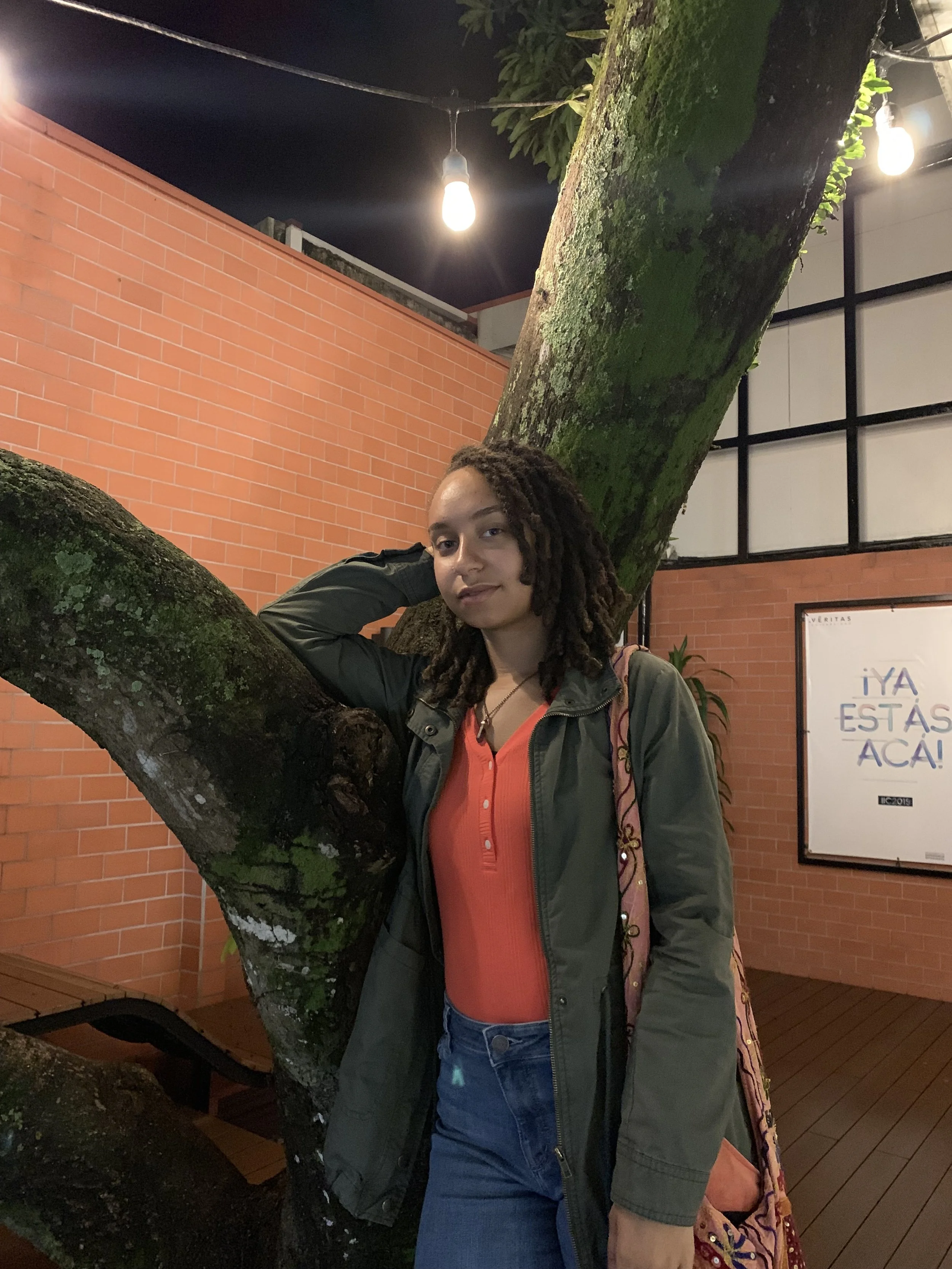
Universidad Veritas in San José, Costa Rica fall 2019
“I had begun my journey […] wanting to learn Spanish so that I could connect with other Black people across the Americas…”
In spring 2019, I was unsure about graduate school and had been presented with the opportunity to graduate from college a semester early. Around that same time, a Black woman scholar Zoomed into one of my public history classes at the amazing historically Black North Carolina Central University while she was on her way to conduct research in Brazil. In addition to English, she spoke Portuguese and Spanish and was learning French, not simply for the sake of being multilingual but because she wanted to connect with African-descended people across the colonized Western world. That idea stayed with me. Not long after, another Black woman professor—my professor for Black Feminist Thought and Theory—encouraged me to think seriously about what I wanted to do, and what I wanted to learn, with the extra semester I had available. My answer was simple: “I want to learn Spanish.” By then, learning Spanish had become connected in my mind to something larger… I wanted another way to communicate with Black people across the Americas. She encouraged me to study abroad in a Spanish-speaking country, and fortunately, my HBCU had programs that made that possibility real. North Carolina Central University had a study-abroad program in Costa Rica, and that decision would ultimately change the direction of my life and scholarship. Looking back, I am struck by how integral Black women were to that development. One modeled for me what it could mean to approach the African diaspora through language, and another pushed me to follow my curiosity beyond the classroom. Long before Black women became central historical actors in my own scholarship, Black women scholars were already teaching me how to ask bigger questions about the world.
Before I even arrived in Costa Rica that fall, however, I spent the summer conducting research at the Schomburg Center for Research in Black Culture in Harlem. I had long been intellectually interested in Black nationalism, Pan-Africanism, and the movement of Black political ideas across borders. After all, my desire to become a historian grew in large part out of reading The Autobiography of Malcolm X when I was sixteen years old. I initially went to the Schomburg expecting to research Marcus Garvey’s ideas about repatriation and the role that returning to Africa played in Black visions of liberation. But because I knew I would soon be studying abroad in Costa Rica (and because I had become increasingly curious about how I would connect with Black people while I was there) I decided to shift my summer research project toward the UNIA and Garveyism in Costa Rica. At the same time, I began learning more about Garvey’s own experiences in Central America, including the time he spent working as a timekeeper on banana plantations and the political agitation he encountered and participated in there. What began as a relatively small adjustment to a summer research project ultimately gave me my first real glimpse of the questions that would follow me for the next few years.
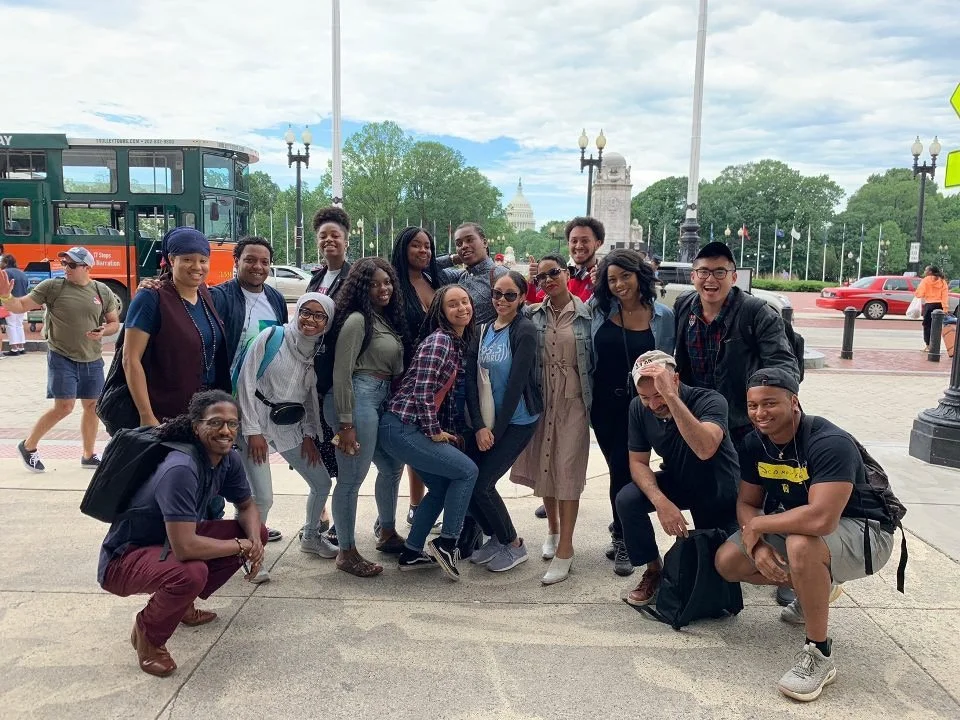
Schomburg-Mellon Humanities Summer Institute fellows in 2019
While living and researching in New York City that summer, I also became increasingly fascinated by the continued presence of Garvey’s legacy in Black political memory. People can grow up learning very little about Marcus Garvey, yet just blocks south of the Schomburg sits a park bearing his name, while a major boulevard in Brooklyn does the same. I could not help but notice the ongoing commitment to Pan-African ideals and the regular commemoration of Garvey in the city’s Black communities. When I gave my final presentation at the end of the fellowship, I was overwhelmed by the continuing interest in Garvey and his political ideas, but also by people’s curiosity about the different lenses through which his influence could be interpreted. That experience pushed me to think of Garveyism as more than a historical movement confined to the early twentieth century but as a political tradition with an afterlife that communities continued to remember, reinterpret, and make meaningful in the present.
Imagine my surprise, then, when I arrived on Costa Rica’s Caribbean coast and encountered that afterlife again in an entirely different national setting. I saw red, black, and green Pan-African flags flying; heard Spanish mingling with Caribbean-accented English and rhythms; tasted pollo en salsa caribeña and rice and beans; felt the weight of the humid Caribbean air and salty sea against my skin; and felt an almost immediate sense of diasporic connectedness. I had gone to Costa Rica because I wanted to learn Spanish, but I did not yet realize that Spanish would become one of the central historical problems of my career. I immediately began asking questions. What does it mean for an Anglophone, English-speaking leader from Jamaica based in Harlem to have this kind of impact on the political imaginations of Black people living in a Spanish-speaking nation? What does it mean for Limón, Costa Rica, and New York City to continue celebrating Marcus Garvey more than eighty years after his death, each in their own ways? What does it mean for his legacy to transcend the barriers of nationality and language? Those questions transformed Costa Rica from the place where I had gone to study Spanish into a place through which I began to understand the possibilities (and complications) of Black diasporic connection. ***Side note: it was at the Schomburg when a literary scholar of the African diaspora presented his research to us fellows and I couldn’t understand what dècalage was supposed to mean. To my co-fellows: IYKYK. Ironically, dècalage has become more important to my work with each passing day.***
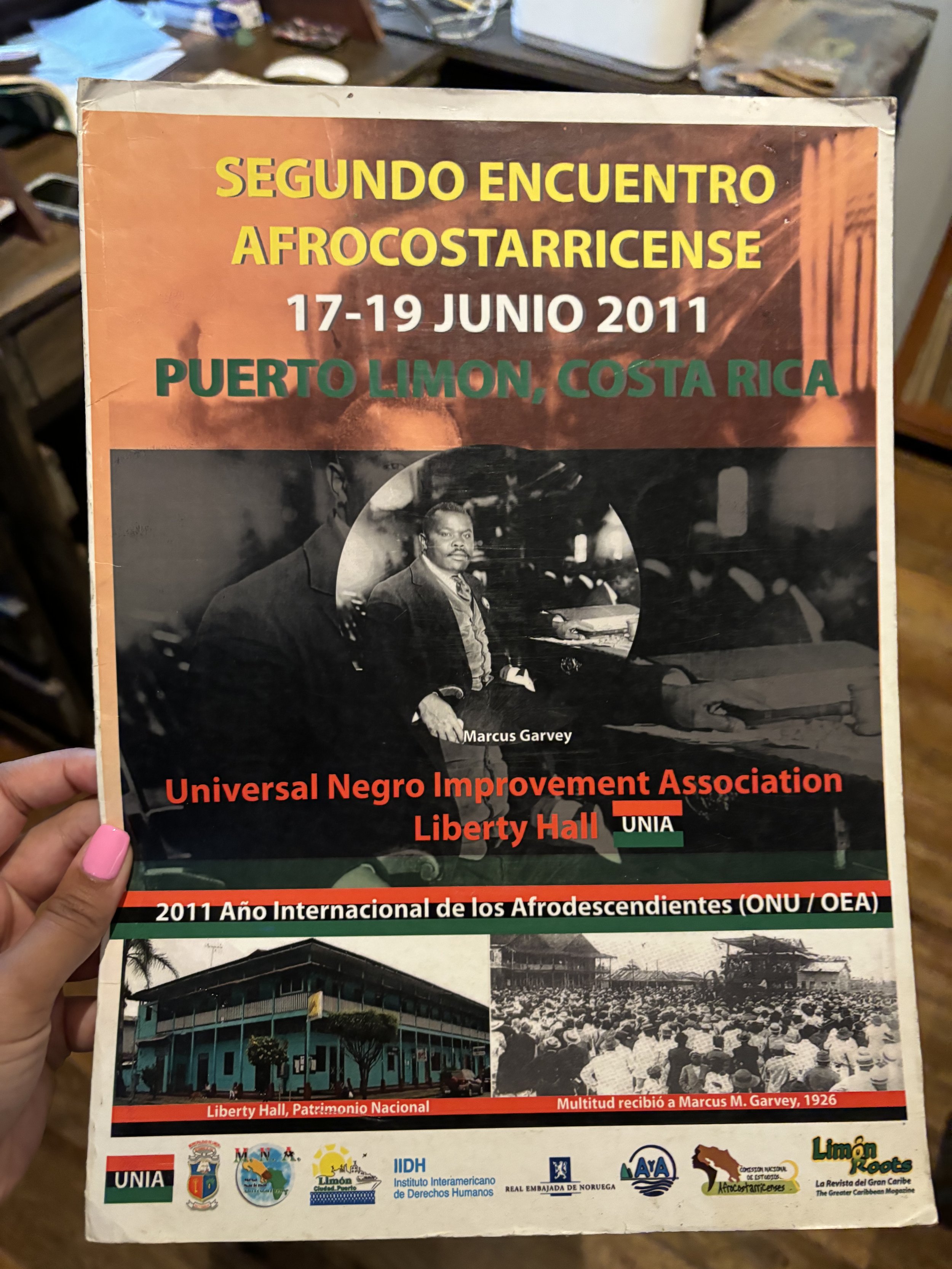
Thank you to Marianela Muñoz-Muñoz for granting me access to her personal collection.
Two years later, I completed a master’s thesis that traced the labor of bilingual women in the Universal Negro Improvement Association. By then, I had become increasingly curious about how an organization with predominantly Anglophone leadership could disseminate a political message to Black people of different nationalities, ethnicities, and languages across the world. Using the Negro World heavily (and almost solely, in huge part due to the pandemic), I realized that interlingual translation was an under-discussed component of what made the UNIA one of the largest Black mass movements of the twentieth century. I found significant instances of men translating at division meetings, and those occasions often received explicit acknowledgement in the newspaper. For instance, the editor of the Negro World’s Spanish-language section, M. A. Figueroa, was a man who received well-deserved significant attention in local and international Black newspapers. But when I looked at the interlingual labor women performed, I noticed that it was not reported with the same degree of recognition, even when the women themselves occupied important political positions. Their translation could be mentioned as though it were quotidian, including when the person doing that labor was international organizer Maymie de Mena. Translation was important enough to be publicly recognized when men performed it, yet similar labor by women could disappear into the category of ordinary organizational work. I began to see that the question was not simply whether women translated, but how gender shaped which forms of political labor were recognized as significant in the first place.
At a surface level, bilingualism is an impressive skill. But for Anglophone Black migrants in unfamiliar linguistic terrain to learn Spanish well enough to communicate across communities was linguistic competency as much as it was the labor of diasporic connection. Translation made communication across national and linguistic boundaries possible and, in doing so, helped make the very ideal of Black internationalism practicable. That discrepancy changed the way I understood both the movement and the archive.
That master’s thesis became the genesis of something much bigger when another seemingly simple question redirected my research yet again. In a directed reading with one of my favorite professors—whose scholarship formed part of the foundation for many of my initial questions—we were reading about Afro-Caribbean migrants in Panama and their contributions to the Black transnational press when I asked, “When did this community learn Spanish?” Having already spent extended periods in Costa Rica and Panama, I knew that language use within Black communities had changed across generations, and I was ultimately trying to understand when that transition occurred and what produced it. The scholar whose work I regard so highly did not really have an answer, which immediately told me that the question was far less straightforward than I had assumed. I had begun my journey two and a half years earlier wanting to learn Spanish so that I could connect with other Black people across the Americas and then I found myself asking how Black Caribbean migrants had navigated that same linguistic terrain historically. Over the next four or five years, answering that question would become the work that fundamentally reshaped my understanding of language, migration, citizenship, gender, and Black diasporic belonging.
